
After nearly a year of persistent testicular pain accompanied by frequent urination, a 50-year-old man was shocked to learn he had multiple masses in his scrotum caused by a rare condition.

The doctors performed surgery on the patient.
The patient, identified as Mr. T., sought medical help after enduring dull pain in both testicles along with urinary urgency for almost a year.
According to his medical history, he had previously visited a local healthcare facility but assumed the condition was minor and stopped treatment on his own. Over time, his scrotum became increasingly swollen, and he was able to feel firm lumps. His daily activities and mobility also became more uncomfortable.
Recently, following a recommendation from an acquaintance, he decided to undergo a thorough examination. The results came as a surprise when urology specialists обнаружили multiple tumors in both epididymides.
Specifically, the left testicle had three small masses measuring 0.5–1 cm, while the right side contained two larger masses, two to three times bigger. Given this condition, the patient was promptly scheduled for surgery.
During the procedure, doctors found that the masses contained a pale yellow, cheese-like substance. Pathology results later confirmed a diagnosis of epididymal tuberculosis—a rare condition that can easily be overlooked if based solely on early symptoms.
After surgery, the patient received anti-tuberculosis medication following an intensive treatment regimen. After seven days of monitoring and treatment, his condition stabilized, and he was discharged with a follow-up plan.
A Rare but Overlooked Condition
According to Dr. Lê Nguyễn Phú from the Department of Urology, male genital tuberculosis is not common and typically affects men of working age. Among genital organs, the epididymis is the most frequently involved site.
The disease can originate from latent tuberculosis or spread through the bloodstream, lymphatic system, or even retrograde from the urinary tract.
Notably, symptoms are often mild and non-specific. Patients may experience slight scrotal swelling, persistent mild pain, or occasional fluid accumulation or thickening of the scrotal skin. As a result, the condition is often mistaken for common inflammation and inadequately treated.
Risks of Delayed Diagnosis
If not detected or treated early, granulomas in the epididymis can lead to chronic inflammation, causing fibrosis, narrowing, and blockage of the vas deferens.
As the disease progresses, these granulomas may undergo caseous necrosis, enlarging and making the epididymis irregular and hardened. In severe cases, they may adhere to the skin, leading to ulceration of the scrotum.
Serious complications can significantly affect male fertility.
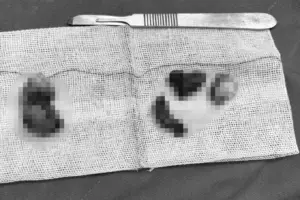
The tumors were removed from the patient’s genital area after the surgery.
Treatment and Recurrence Risk
Current treatment options for epididymal tuberculosis include:
-
Medical therapy: A standard 6-month anti-tuberculosis regimen, including 2 months of intensive treatment followed by 4 months of maintenance
-
Surgical intervention: In severe cases unresponsive to medication, procedures may include removal of the epididymis or complete removal of the testicle and epididymis
Dr. Phú also noted that studies worldwide show tuberculosis can recur in about 2–6% of pulmonary cases and 6.3–22% in genitourinary tuberculosis, even after 12 months of treatment.
For recurrent cases, it is essential to identify the bacteria and test for drug sensitivity, as well as maintain long-term follow-up after completing treatment.
Medical Advice
Doctors recommend that if testicular or epididymal inflammation recurs frequently and does not improve with antibiotics, patients should consider less common causes such as tuberculosis or tumors.
Early detection and appropriate treatment are crucial to preventing serious complications in the future.