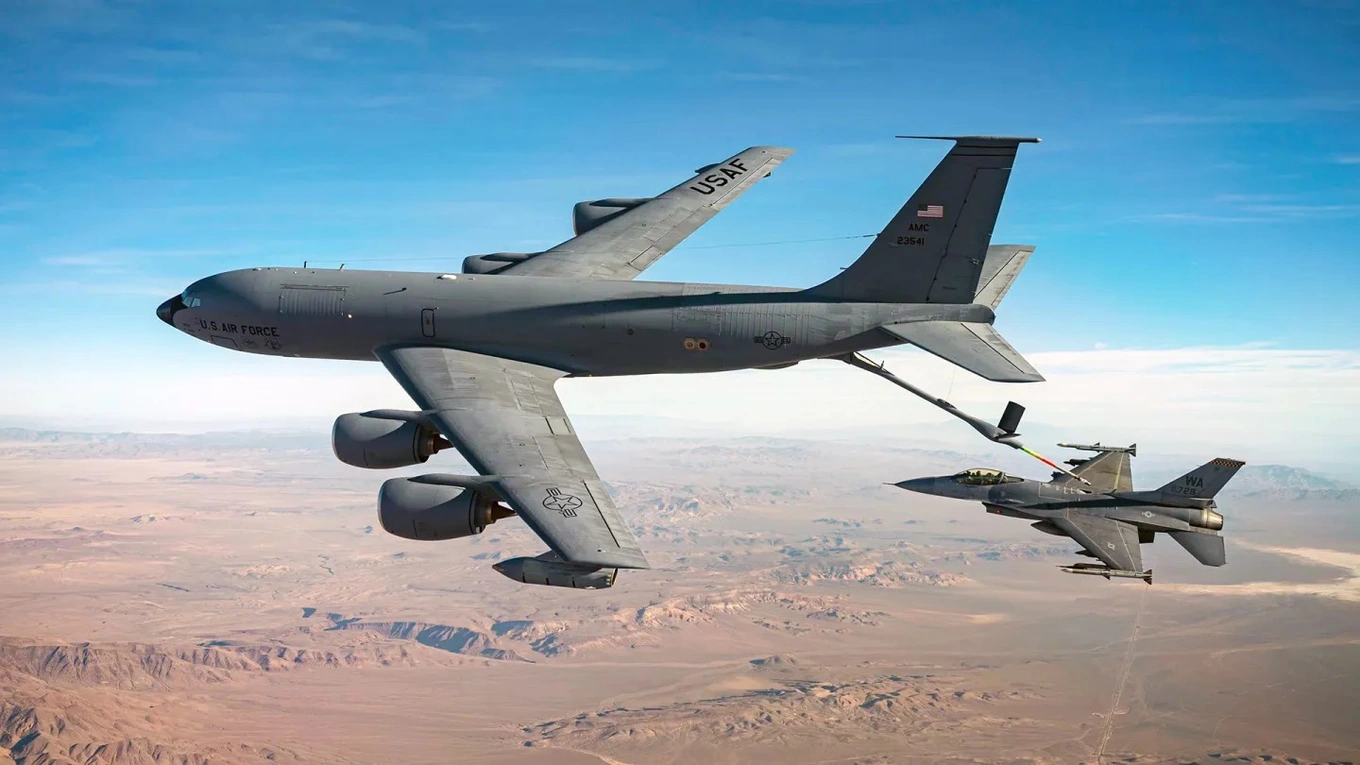
A US KC-135 Stratotanker aerial refueling aircraft has crashed in western Iraq. The US military emphasized that the incident “was not caused by enemy fire or friendly fire.”
“The US Central Command is aware of reports that a US Boeing KC-135 Stratotanker aerial refueling aircraft has crashed. The incident occurred in friendly airspace as part of Operation Rough Rider, and rescue efforts are currently underway,” according to a statement from US Central Command (CENTCOM).

The statement added: “Two aircraft were involved in the incident. One crashed in western Iraq, while the second landed safely. This was not the result of enemy fire or friendly fire.”
The Times of Israel reported that the second tanker aircraft landed safely at Israel’s Ben Gurion Airport.
The statement said that more information will be released as the situation becomes clearer.
This marks the first crash of a Boeing KC-135 Stratotanker while supporting combat operations since 2013, when one crashed in northern Kyrgyzstan, killing all three crew members on board.
According to the US Air Force, a Boeing KC-135 Stratotanker tanker crew typically consists of three to four personnel: a pilot, a co-pilot, and a boom operator responsible for refueling other aircraft mid-air from the KC-135. Some missions also require a navigator as part of the flight crew.
Last week, three US F-15E Strike Eagle fighter jets were shot down over Kuwait in a friendly-fire incident. All six crew members were able to eject safely.
Produced by Boeing, the KC-135 remains one of the most important aerial refueling aircraft in the US military fleet. It extends the operational range and endurance of fighter jets and bombers, serving as a cornerstone of the US Air Force’s deterrence capability and rapid force projection. Its ability to maintain a continuous presence in the air makes the KC-135 an indispensable strategic asset for both defense and operational readiness across the region.