As U.S. President Donald Trump calls on allies to deploy warships to safeguard shipping through the Strait of Hormuz, some naval experts warn that the effort carries significant risks.
Table of Contents
ToggleU.S. Urges Allies to Support Escort Missions
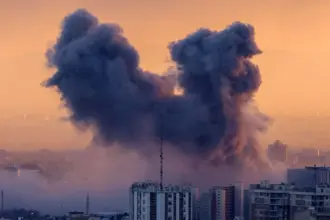
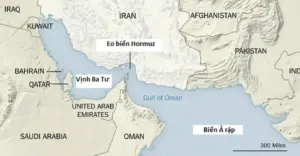
Commercial shipping through the Strait of Hormuz has nearly come to a halt since the United States and Israel launched airstrikes on Iran, prompting Tehran to declare it would target any vessels linked to the two countries or their partners.
Roughly 20% of the world’s oil supply—along with comparable or greater volumes of liquefied natural gas and fertilizer products—passes through the narrow waterway near Iran en route to global markets. The disruption has driven prices sharply higher.
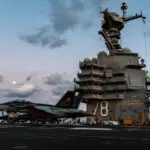
To ease economic pressure, the Trump administration is planning for the U.S. Navy to escort commercial vessels through the strait. Washington has also urged allies such as Japan, South Korea, NATO members, and even China to contribute military ships to the mission.
So far, no country has made a public commitment, despite Trump’s claims that some have agreed privately.
Naval analysts say this hesitation underscores the high level of risk involved.
Experts estimate that even if successful, escort operations would restore only about 10% of pre-war shipping traffic through the route.
Arsenio Dominguez, Secretary-General of the International Maritime Organization (IMO), said naval escorts in the Strait of Hormuz cannot “guarantee 100% safety” for vessels attempting to transit the waterway.
He stressed that military support is “not a long-term or sustainable solution” for reopening the strait, and warned of serious concerns that ships stranded in the Persian Gulf could run out of food and supplies for their crews.
The IMO Council is set to hold an extraordinary meeting at its London headquarters this week to discuss the impact of the Middle East crisis on shipping and seafarers.
Dominguez also urged ship operators to “not set sail, not put seafarers at risk, and not place vessels in danger.”
A High-Risk Plan
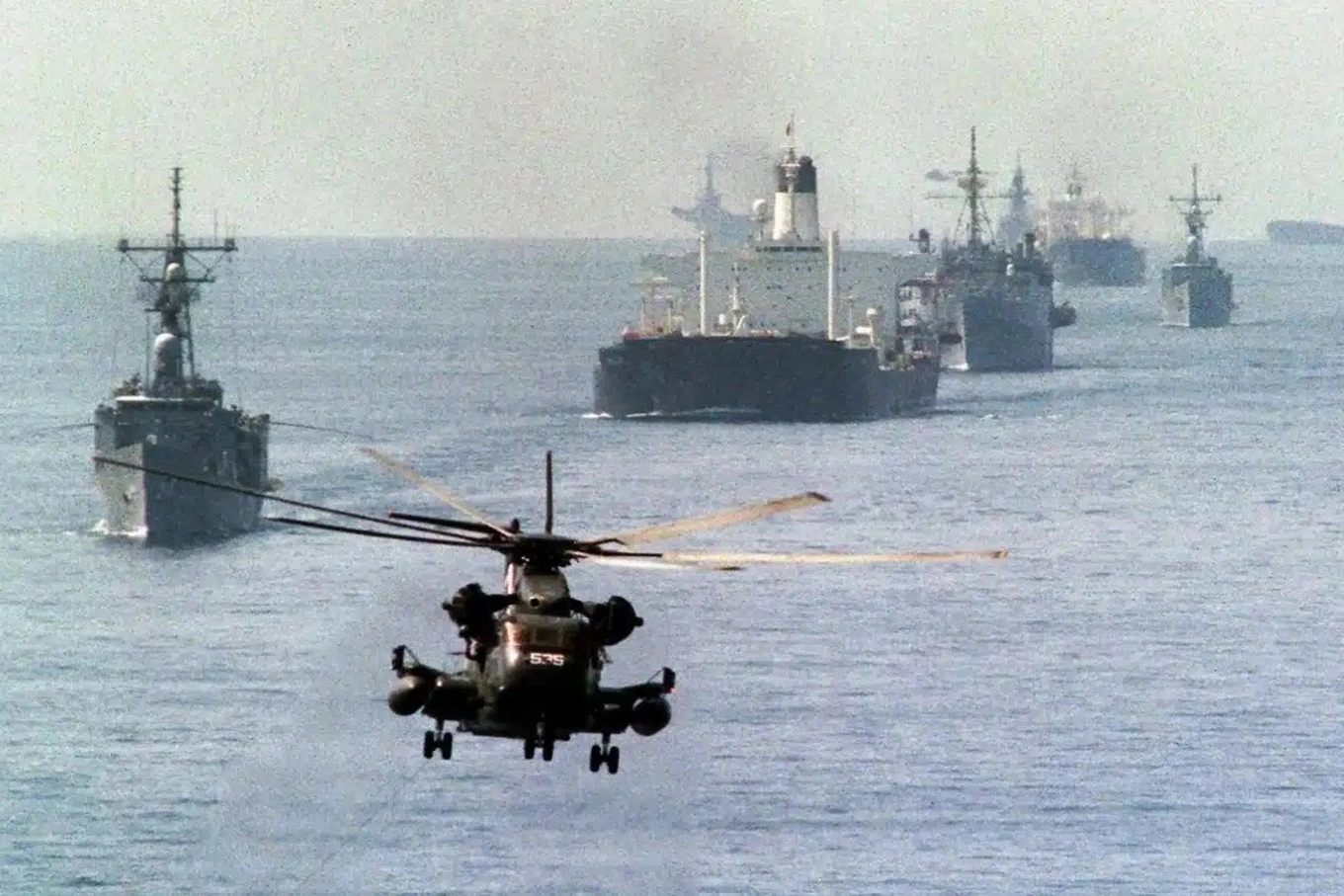
Naval escort operations are highly complex, requiring close coordination between sea and air forces to protect both commercial vessels and the warships themselves.
Coordinating these elements in the constrained “chokepoint” of the Strait of Hormuz presents a formidable challenge.
One key issue is space. At its narrowest point, the strait is only about 16 kilometers wide, with even less navigable space available—especially for massive oil tankers.
This leaves both tankers and escorting warships with limited room to maneuver. Warships—likely U.S. Navy destroyers—need space to position themselves effectively against threats such as drones, unmanned surface vessels, or missiles.
In effect, large tankers can create “blind spots” for the escorting ships.
Another challenge is extremely limited reaction time, as Iranian weapons are positioned close to the coastline. “The time from detecting a threat to responding is very, very short,” said naval expert Jennifer Parker.
Analysts note that escorts cannot rely on destroyers alone. Helicopters or strike aircraft must operate nearby to counter drones and unmanned boats, while airborne early warning and control (AWACS) aircraft and surveillance drones must monitor deep into Iranian territory to detect potential missile launches.
Meanwhile, Iranian forces could threaten escort missions using missiles and drones deployable from trucks or from numerous small fishing boats, wooden vessels, or even civilian ships.
“Is it possible to eliminate all these platforms to remove the threat? In my view, it is not feasible,” said analyst Collin Koh.
Airstrikes or ground operations to neutralize launch sites could reduce risks, but would introduce new challenges, including potentially high U.S. ground casualties.
Another issue is the number of warships required. A single U.S. destroyer may only be able to escort one or two tankers at a time, and some experts argue that each tanker may require more than one escort.
Estimates suggest that even a basic escort mission would require 8 to 10 destroyers to protect a convoy of 5 to 10 commercial vessels per transit.
At that ratio, escort missions would only restore shipping capacity to about 10% of pre-conflict levels.
The U.S. Navy currently operates 73 Arleigh Burke-class destroyers, but only about 68%—roughly 50 ships—are combat-ready at any given time, and they are deployed worldwide.
If up to 10 ships are needed per escort mission, the strain on U.S. naval forces would quickly become unsustainable over time.
This helps explain why President Trump has repeatedly called on other nations to participate.
Beyond escorts, mine detection and clearance present another major challenge that the U.S. would struggle to handle alone. Last year, the U.S. Navy decommissioned four dedicated mine countermeasure ships in the Persian Gulf.
Iran, meanwhile, is capable of deploying a wide range of naval mines—from traditional contact mines to more advanced types triggered by sound, magnetic fields, or even ship-counting mechanisms before detonation.
“Mine detection is always a challenge,” said expert Carl Schuster.
Allies such as Japan and South Korea could assist with minesweepers, but even then, these vessels are not a perfect solution. They have limited self-defense capabilities and require protection themselves.
In South Korea’s case, its minesweepers are not designed for prolonged offshore operations in high-risk environments like the Strait of Hormuz.
Despite these obstacles, some experts believe the mission is still feasible, noting that the U.S. Navy dealt with similar Iranian threats in the 1980s and 1990s.
Others, however, are more pessimistic. They argue that modern naval capabilities and fleet sizes are not what they once were, and support systems are only a fraction of what they were four decades ago.
Recent difficulties faced by U.S. and European escort missions in the Red Sea against Houthi forces in Yemen further highlight how challenging it is to protect commercial shipping.
“Forces are now facing a much larger adversary in Iran, with a far more advanced arsenal of drones and missiles,” Koh said.
Some experts also argue that the United States and its partners have underestimated the vital importance of maritime trade to the modern global economy.