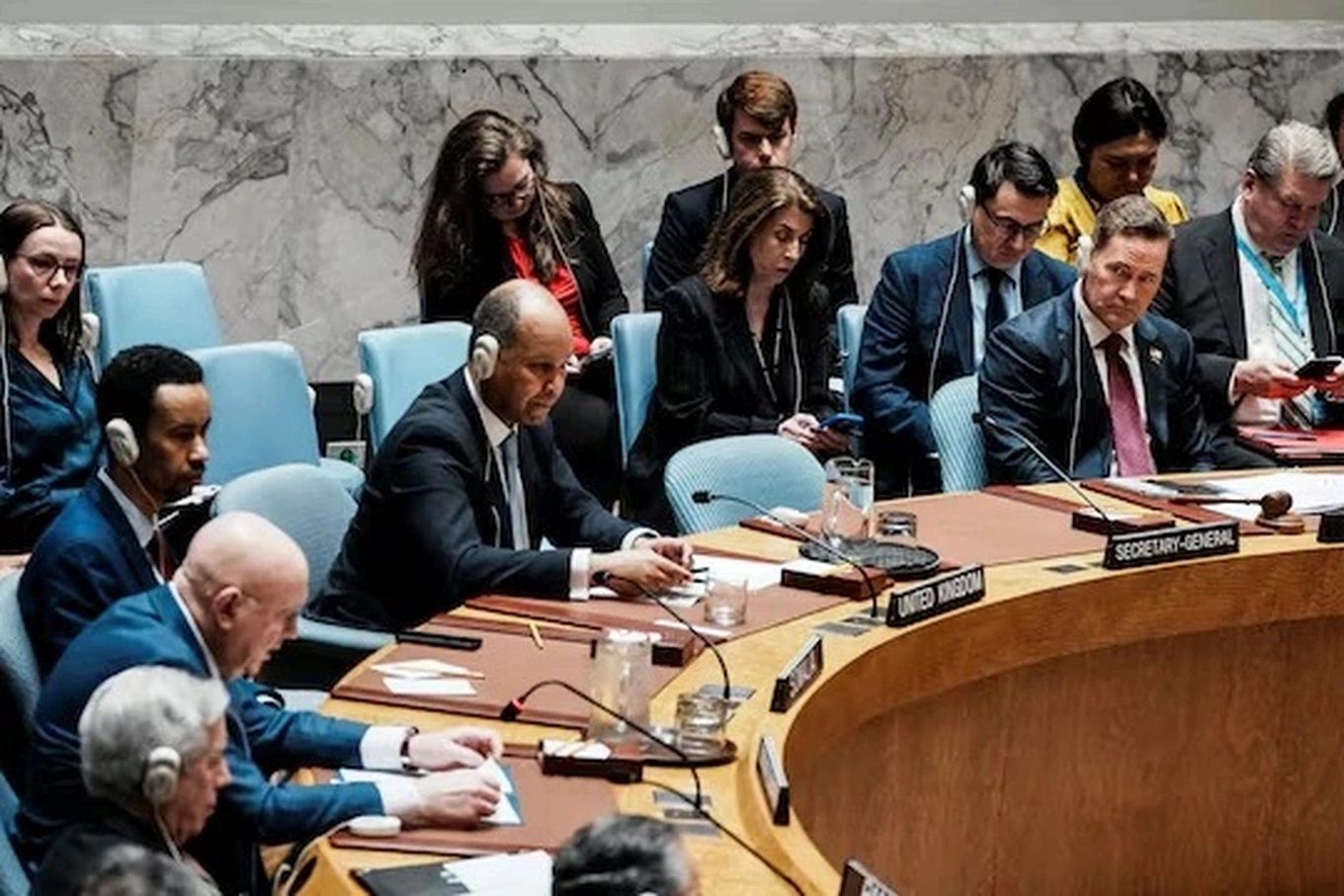
The United Nations Security Council witnessed a sharp exchange between the United States and its Western allies on one side and Russia and China on the other over Iran’s nuclear program, as the conflict involving the United States, Israel and Iran shows no sign of ending.
During the meeting of the 15-member Security Council, currently chaired by the United States this month, Russia and China failed in their attempt to block a discussion on the committee established to monitor and enforce United Nations sanctions on Iran.
Addressing the council, the U.S. special envoy to the UN, Mike Waltz, accused Moscow and Beijing of shielding Tehran by obstructing the work of the so-called United Nations Security Council Resolution 1737 Sanctions Committee.

“All UN member states should enforce the arms embargo on Iran, prohibit the transfer and trade of missile technology, and freeze related financial assets,” Waltz said.
He added that the reimposed UN measures were not arbitrary, but carefully designed to counter the threat posed by Iran’s nuclear, missile and conventional weapons programs, as well as Tehran’s continued support for proxy groups.
Waltz argued that both China and Russia oppose the sanctions committee because “they want to protect their partner Iran and maintain their current defense cooperation.”
He also noted that the International Atomic Energy Agency (IAEA) reiterated last week that Iran has produced and stockpiled uranium enriched to 60% purity, while refusing to allow inspectors access to the material.
Representatives from the United Kingdom and France told the Security Council that reimposing sanctions on Iran is justified because Tehran has failed to address international concerns over its nuclear activities. France said Iran’s nuclear stockpile could be sufficient to produce around 10 nuclear devices.
Meanwhile, Russia’s ambassador to the UN, Vasily Nebenzya, accused the United States and its allies of “stoking hysteria about alleged Iranian plans to obtain nuclear weapons,” claims he said have never been confirmed in IAEA reports.
“This is being done to justify another military adventure against Tehran and to dramatically escalate tensions in the Middle East and beyond,” he said.
China’s representative, Fu Cong, also criticized Washington, arguing that the U.S. military campaign has rendered diplomatic efforts ineffective.
Iran’s ambassador to the UN, Amir Saeid Iravani, later told reporters that Iran’s nuclear program “has always been entirely peaceful” and that Tehran will not recognize any attempts to impose sanctions on the country.
Western governments have long accused Iran of pursuing nuclear weapons capabilities.
The administration of U.S. President Donald Trump has cited that concern to justify airstrikes against Iran. Earlier this month, Trump said Iran could have obtained nuclear weapons within two weeks if the United States had not struck three key Iranian nuclear facilities in June last year. However, that assessment has not been supported by the U.S. intelligence community.