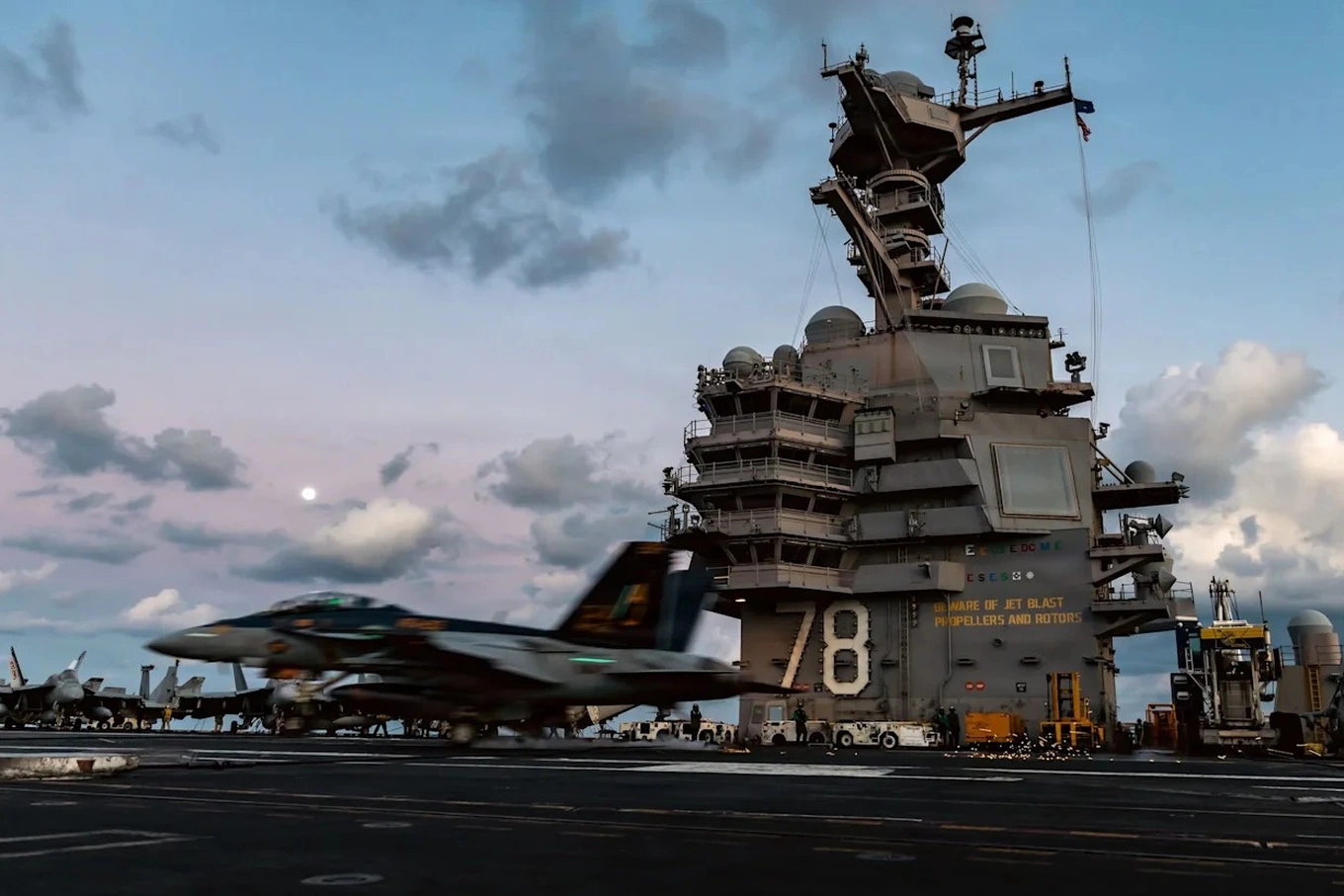
A fire that broke out in a laundry area aboard the USS Gerald R. Ford last week burned for more than 30 hours and left dozens of service members exposed to smoke.
According to The New York Times, citing U.S. sailors and military officials, the blaze began in the ship’s main laundry compartment on March 12.
The U.S. Navy acknowledged the incident in a statement last week, saying the fire had been contained, was not combat-related, and resulted in two sailors sustaining non-life-threatening injuries.
The Navy also stated that combat operations aboard the 100,000-ton carrier—currently deployed in the Red Sea as part of operations related to the conflict with Iran—were not affected.
However, living conditions for the roughly 4,500 personnel on board, including the air wing, were significantly disrupted. It took more than 30 hours for sailors to fully extinguish the fire.
In the aftermath, more than 600 sailors and crew members lost their sleeping quarters and have since been forced to sleep on floors or tables. Many have been unable to do laundry since the incident, and those on board reported that dozens of personnel suffered smoke inhalation.
The U.S. Navy’s Fifth Fleet, which oversees operations in the Persian Gulf and Red Sea, has not yet commented.
The USS Gerald R. Ford is now in its 10th month of deployment, which has also been plagued by ongoing issues with the ship’s plumbing system. NPR reported that in recent years, there have been dozens of external repair requests for the vessel’s piping, including at least 10 during the current deployment.
Since departing its home port in Norfolk, Virginia, last June, the carrier has crossed the Atlantic to the Mediterranean, returned to the Atlantic to support operations in the Caribbean near Venezuela, and has now redeployed to the Middle East.
According to The New York Times, if the current deployment extends into mid-April, it would mark the longest U.S. aircraft carrier deployment in decades.
Crew members have reportedly been informed that their deployment could be extended to May, potentially keeping them at sea for a full year—double the typical deployment duration for a U.S. carrier.
During the wars in Iraq and Afghanistan, U.S. Navy carrier deployments typically lasted around nine months, occasionally slightly longer, though standard deployments are usually about six months. Naval experts say exceeding that duration places significant strain on both the ship and its crew.
“Ships get tired too, and they wear down over extended deployments. You can’t operate a vessel for that long at such a high tempo and expect both the ship and its crew to maintain peak performance,” said retired Rear Admiral John F. Kirby, a former Pentagon spokesperson.
A major maintenance and upgrade period originally scheduled for early this year at the Newport News Shipbuilding yard in Virginia has been delayed.
A U.S. military official said the Pentagon is aware that the carrier is approaching the limits of what a prolonged deployment can sustain. According to the official, the USS George H.W. Bush is preparing to deploy to the Middle East and will likely replace the USS Gerald R. Ford.