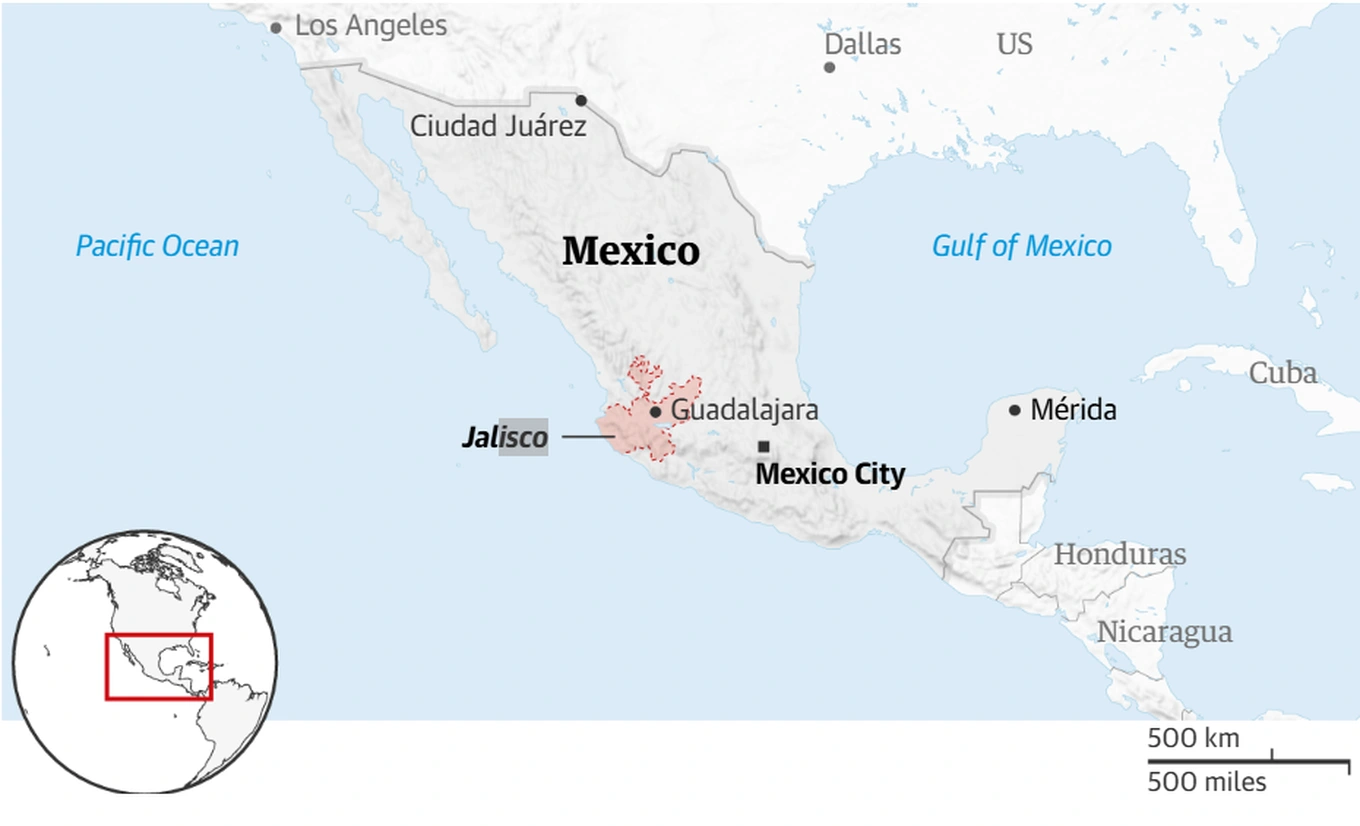
In his final hours, one of the world’s most wanted drug traffickers hid in the mountains of Jalisco with a small team of bodyguards, mounting a fierce last stand against a Mexican military operation determined to capture him.

The life of Nemesio Oseguera Cervantes, better known as “El Mencho,” ended in a remote forest in the state of Jalisco. Severely wounded and armed with a grenade launcher, the notorious crime boss was accompanied by four of his closest lieutenants when he was killed in the early hours of February 22, bringing to a close four decades of drug trafficking and the rise of one of Mexico’s most feared criminal empires, the Jalisco New Generation Cartel (CJNG).
Tracking the fugitive
El Mencho died after being shot by a Mexican Army special forces unit that had spent years gathering intelligence to locate him. According to officials, investigators ultimately pinpointed his whereabouts using a tactic similar to the one that led to the capture of Joaquín “El Chapo” Guzmán a decade earlier—by tracking the visit of a romantic partner.
On February 23, Defense Minister Ricardo Trevilla Trejo revealed new details about the operation, which he described as one of Mexico’s most significant actions against organized crime in recent years.
He emphasized the complexity of the intelligence work involved, including years of analyzing the cartel leader’s contacts and identifying the places he frequently visited.
In El Mencho’s case, most of the intelligence work was carried out by the Mexican Army, although authorities also received “additional information” from the United States.
“There was a great deal of information provided by the U.S. which, when combined with our own data, allowed us to determine his precise location,” the general said.

For some time, investigators had focused on Tapalpa, a mountain town of roughly 20,000 residents, believing the CJNG leader was hiding there.
On February 20, confirmation finally arrived: one of El Mencho’s girlfriends had been taken to the town. Authorities discovered this by monitoring a trusted associate of the woman, who escorted her to meet the cartel boss.
“She met El Mencho and left the property on February 21. Intelligence indicated that he remained there with his security team,” Trevilla said.
For years, the Mexican government had asked the same question: how many layers of protection surrounded one of the most powerful criminals in the world—and how many lives might be lost trying to capture him?
On February 21, however, intelligence suggested that El Mencho had only about ten bodyguards with him in Tapalpa.
Mexican special forces prepared a coordinated ground-and-air assault. Six helicopters were stationed in neighboring states around Jalisco to preserve secrecy and maintain the element of surprise. In the early hours of February 22, final confirmation of his location was received.
Ground troops moved in to surround the hideout, supported by two aircraft.
A violent final stand
The operation initially aimed to capture El Mencho alive. But his security team opened fire first.
“They fired on our soldiers. El Mencho came out with a group carrying a large amount of weapons. It was a very violent attack by the criminal organization,” Trevilla said. “Our forces returned fire, and eight criminals were killed at the scene.”
Two soldiers were wounded in the clash. During the search of the compound, troops seized seven rifles, eight vehicles, two all-terrain vehicles and two grenade launchers—one of which was similar to the weapon used to shoot down a helicopter during a 2015 operation targeting El Mencho.
The operation continued into the surrounding forest, where the cartel leader fled on foot with four of his most trusted bodyguards.
Special forces units pursued them and established a perimeter.
“They found him hiding in dense vegetation, and he opened fire on the soldiers. They were also carrying a grenade launcher but did not use it,” Trevilla said.
In the ensuing gunfight, one soldier, El Mencho and two of his bodyguards were wounded. Two other CJNG members were captured. Troops seized another grenade launcher, three rifles and two handguns.
After the area was secured, medics were called to treat the wounded. The cartel leader and two of his bodyguards were found in critical condition.
A helicopter was dispatched to transport them to Guadalajara, but the drug lord and the two gunmen died during the flight.
Because of security concerns, the helicopter diverted and did not return to Guadalajara—CJNG’s stronghold—but instead headed to Morelia, where a Mexican Air Force transport aircraft was waiting to carry the bodies to Mexico City.
“We could not go to Guadalajara, especially due to the risk of further violence by this group in the state capital,” Trevilla explained.
Cartel retaliation
CJNG responded quickly.
El Mencho’s right-hand man, Hugo César Macías, also known as “El Tuli,” organized roadblocks and violent actions from the town of El Grullo, about 100 kilometers from where the operation took place.
The cartel reportedly offered a reward of 20,000 pesos for every soldier killed.
A unit of paratroopers was deployed. El Tuli attempted to escape by car but was also killed. Authorities found nearly $1 million in cash and 7.2 million pesos in his possession.
Across Mexico, the cartel established 252 roadblocks in 20 states on February 22. Vehicles and businesses were set on fire in incidents that spread across nearly half the country, forcing several states to suspend school activities on February 23 and prompting an emergency meeting of the national security cabinet.
The deadliest violence did not occur during the Tapalpa raid itself but in the wave of cartel retaliation that followed.
CJNG militants killed 25 members of the National Guard, a prison guard, an investigator from the Jalisco Attorney General’s Office, and a civilian. On the other side, 30 cartel gunmen were killed in Jalisco alone. In Michoacán, 15 soldiers were wounded and four gunmen were killed.
In total, 45 cartel members were killed during operations linked to the hunt for El Mencho. Meanwhile, 26 security personnel and one civilian also lost their lives.
Mexican President Claudia Sheinbaum praised the “extraordinary” efforts of the country’s armed forces and reassured the public that roadblocks had been dismantled and flights to Jalisco would soon return to normal.
She said she had been informed about the operation early on and ordered the establishment of a national command center coordinating all security forces.
Now, attention turns to what comes next: how the powerful cartel empire will reorganize after losing its leader—and how Mexico will respond to a criminal network suddenly left without its head.